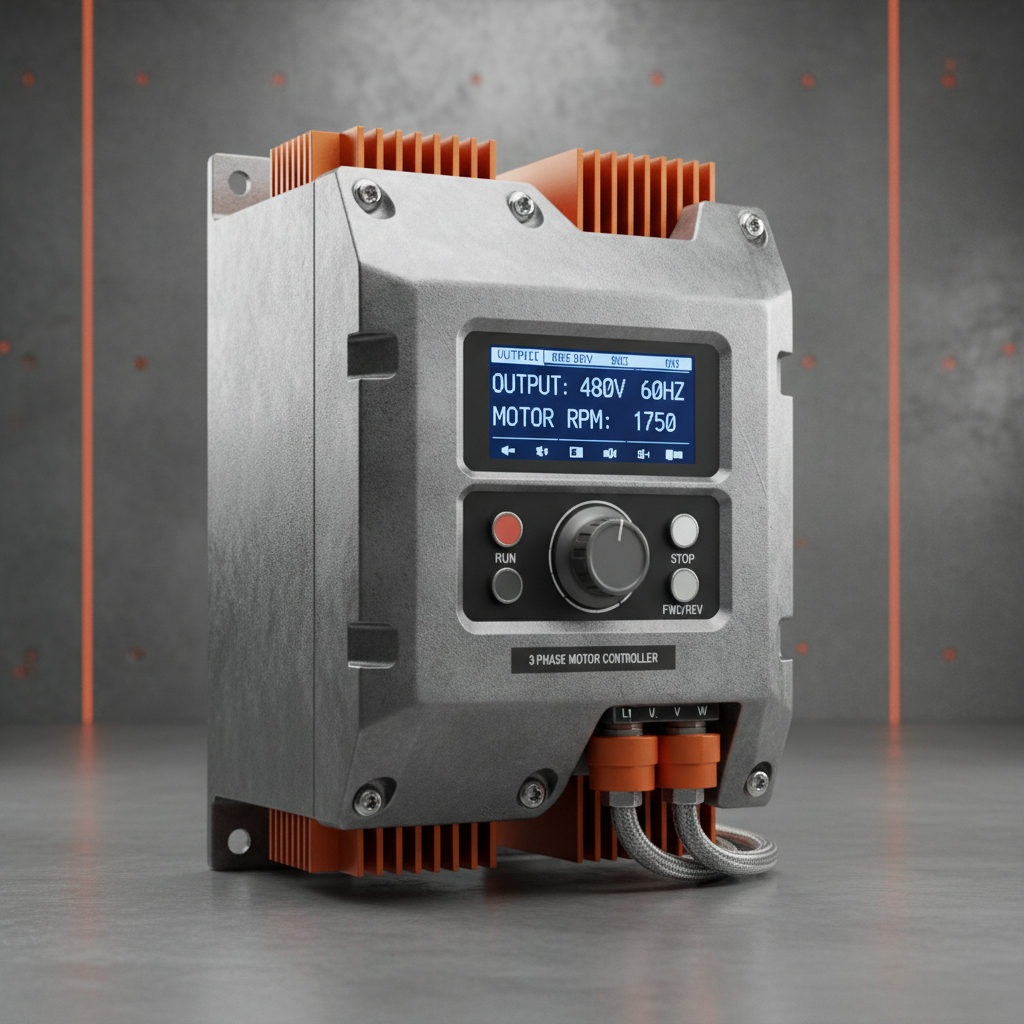
Many industrial facilities operate in environments where three-phase power is unavailable, creating a technical bottleneck for implementing modern motor control. The adoption of a 1 phase vfd allows operators to bridge this gap, enabling the use of high-efficiency three-phase motors on single-phase power supplies.
While traditional motor starters offer binary on/off control, variable frequency drives introduce the ability to modulate speed and torque. This transition is critical for reducing mechanical stress on equipment and optimizing energy consumption in small-scale manufacturing and workshop settings.
Understanding the trade-offs between power capacity, harmonic distortion, and installation complexity is essential for procurement officers and engineers seeking to modernize their electromechanical systems without costly electrical infrastructure upgrades.

Bridging the Gap Between Single-Phase Power and Three-Phase Motors

In many light-industrial and commercial settings, the available electrical grid is limited to single-phase power. However, the vast majority of high-performance industrial motors are designed for three-phase operation due to their superior efficiency and reliability. A 1 phase vfd solves this discrepancy by converting single-phase AC into a variable-frequency three-phase output.
This technology is not merely a convenience but a strategic tool for reducing the Total Cost of Ownership (TCO). Instead of investing in expensive utility upgrades to bring three-phase power to a remote part of a factory, businesses can deploy a VFD to manage the conversion locally at the machine level.
From a system architecture perspective, this allows for a more modular approach to factory layout. Equipment can be moved or added to areas with limited power infrastructure without requiring a complete redesign of the electrical distribution board, provided the kVA capacity of the single-phase line is sufficient.
Technical Core: How Single-Phase Inputs Drive Industrial Loads
The internal mechanism of a single-phase VFD involves a rectifier stage that converts AC to DC, followed by a DC bus capacitor that smooths the voltage. The inverter stage then uses Pulse Width Modulation (PWM) to synthesize a three-phase AC output, allowing the motor to operate at varying speeds.
Because the drive must compensate for the missing phases, the input current is concentrated on a single conductor. This necessitates careful selection of circuit breakers and wiring gauges to prevent overheating and voltage drops, especially during high-torque start-up sequences.
Modern drives incorporate advanced algorithms to maintain torque stability at low frequencies, which is critical for applications like conveyor belts or packaging machinery where consistent movement is required regardless of the input power fluctuations.
Deployment Scenarios in Discrete Automation and Mechanical Engineering
The application of these drives extends across various sectors of the electrical machinery and equipment industry. In textile machinery and packaging lines, the ability to precisely control the speed of a three-phase motor using a single-phase source allows for seamless synchronization between different stages of the production process.
In general mechanical engineering, these devices are frequently found in special-purpose machines where a small footprint and simplified wiring are required. For instance, in automated picking and placing systems, the VFD provides the ramp-up and ramp-down control necessary to prevent product damage during rapid movement.
Furthermore, in water and wastewater treatment for small municipalities, single-phase VFDs enable the control of centrifugal pumps. By adjusting the motor speed to match the actual flow requirement, operators can significantly reduce energy waste compared to using throttling valves.
Evaluating Operational Efficiency and Torque Stability Metrics
When comparing a standard across-the-line starter to a VFD-driven system, the most immediate improvement is seen in the starting current. While a direct-on-line starter can cause current spikes up to six times the rated current, a VFD provides a controlled soft-start.
This reduction in inrush current protects the single-phase grid from voltage sags that could otherwise affect other sensitive electronic equipment, such as PLCs or interface modules in the same circuit.
1 phase vfd Performance Metrics
The data indicates that while energy efficiency at full load is comparable to three-phase systems, the real gains are realized during partial load operations. The ability to operate at 60% or 80% speed leads to exponential energy savings based on the affinity laws of centrifugal loads.
Strategic Procurement and Installation Best Practices
Procuring the correct drive requires a focus on the "input-to-output" ratio. Since a single-phase VFD draws more current from the wall than it provides to the motor, the input fuse and wiring must be sized according to the input current rating, not the motor's nameplate current.
Installation should prioritize the separation of power cables from signal cables. Because the PWM output of a VFD creates high-frequency electromagnetic interference (EMI), using shielded cables for the motor connection is non-negotiable to prevent glitches in nearby control interfaces.
For those integrating these drives into larger automation frameworks, ensuring compatibility with controllers—such as those in the S7-1200 or S7-1500 series—allows for remote speed adjustment and real-time monitoring of motor health via industrial networks.
The Shift Toward Integrated Smart Controllers and IoT Connectivity
The future of motor control is moving away from standalone drives toward integrated "smart" nodes. We are likely to see a convergence where the VFD functionality is embedded more deeply into the controller architecture, reducing the need for separate hardware modules.
Cloud-based monitoring is expected to become standard, allowing maintenance teams to track torque patterns and temperature trends remotely. This shift toward predictive maintenance could allow companies to replace VFDs based on actual component wear rather than fixed schedules.
Furthermore, the development of wide-bandgap semiconductors, such as Silicon Carbide (SiC), may lead to VFDs with smaller footprints and lower heat generation, making them even more viable for extremely compact machinery where space is at a premium.
Selection Framework for Variable Frequency Drive Configurations
Selecting a VFD requires balancing the technical requirements of the motor against the limitations of the power supply. Not all single-phase drives are created equal; some are designed for light-duty fans, while others are built for high-torque industrial conveyors.
The following framework helps procurement teams categorize the necessary specifications based on the intended application and expected operating conditions.
| Application Type | Load Characteristic | Critical Parameter | Recommended Focus |
|---|---|---|---|
| Variable Torque | Airflow Volume | Energy Efficiency | |
| Constant Torque | Starting Inertia | Current Overload Cap | |
| Precision Load | Speed Stability | PWM Switching Frequency | |
| Intermittent Load | Cycle Frequency | Thermal Management | |
| High Precision | Tension Control | Deceleration Accuracy | |
| Heavy Start Load | Braking Torque | Dynamic Braking Resistor |
Ultimately, the choice depends on the balance between initial capital expenditure and long-term operational reliability. Those seeking comprehensive electromechanical solutions can review the product ranges available through www.oukeconstruction.com to ensure system compatibility.
Frequently Asked Questions
Conclusion
Implementing a 1 phase vfd is a highly effective strategy for industrial operators who need the performance of three-phase machinery without the burden of expensive electrical infrastructure upgrades. By providing precise speed control and reducing mechanical stress, these drives extend the lifespan of equipment and lower overall energy costs.
For organizations looking to optimize their automation and electromechanical control systems, focusing on input current requirements and EMI shielding is the key to a stable installation. Further technical specifications and product compatibility can be explored via www.oukeconstruction.com.